Chess.com PubAPI
Completed games · PGN
Built from the board. Designed for better questions.
Chess is part of my life outside software. At 1839 Rapid and 1817 Blitz, I care about what happens after a game: the decisions I missed, the openings I keep returning to, and the questions worth asking before the next one.
I wanted to bring that review into a conversation with ChatGPT without repeatedly copying PGN files and rebuilding the context. My games already existed on Chess.com. The missing piece was a dependable way to make them readable.
So I built a small bridge: one permanent URL, the latest completed games, and the original record preserved. A personal reason to build it became an engineering problem about validation, chess notation, reliable APIs, and keeping data in sync.
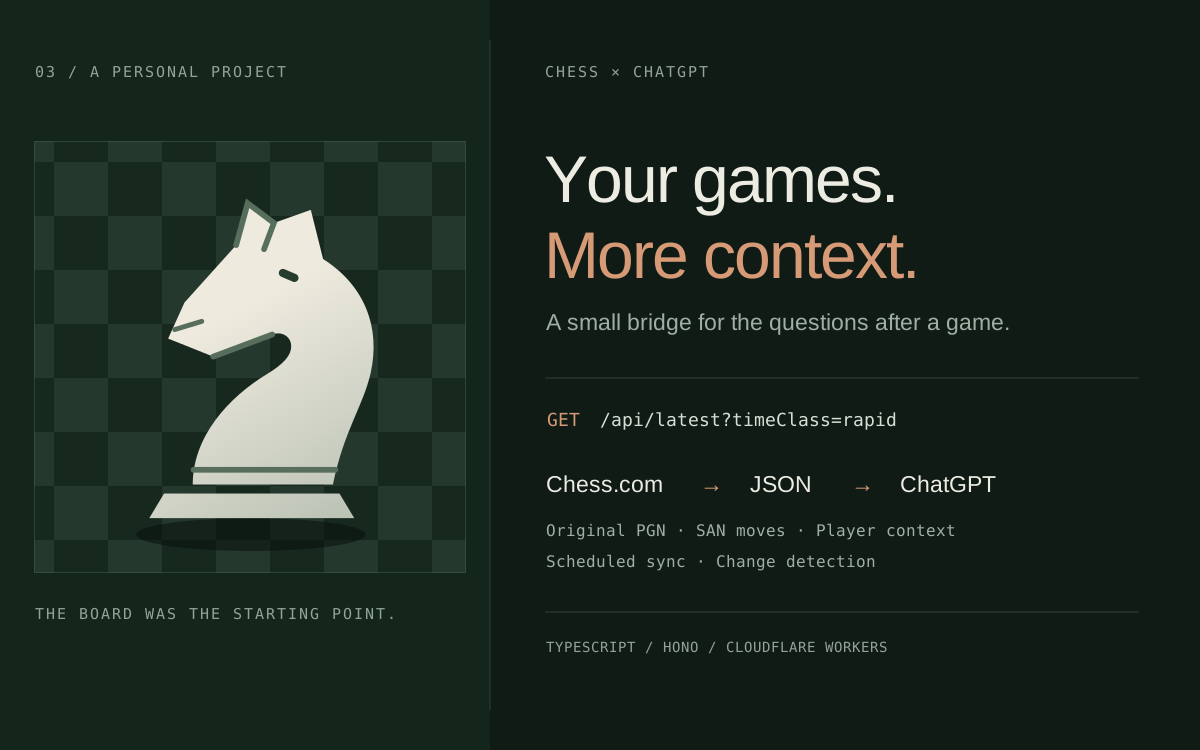
A personal bridge from Chess.com to ChatGPT: completed games become structured JSON with the original PGN, move history, and player context intact.
Personal project · API design, upstream integration, PGN normalization, scheduled synchronization, and shared deployment adapters.
Live Cloudflare API · Health endpoint verified · Private source
Reviewing one game is easy to start manually. Repeatedly retrieving the right games, preserving their complete move history, and giving ChatGPT consistent player-relative context creates friction. Monthly archives also need filtering and validation before they are useful.
A TypeScript/Hono service reads the official Chess.com PubAPI for a fixed player. Zod validates upstream payloads; chess.js parses PGN into moves and positions. Read-only endpoints expose games, profile, ratings, and objective summaries. A separate Cloudflare Cron job maintains JSON snapshots in a GitHub data repository.
Completed games · PGN
Zod · Filters · Deduplication
chess.js · SAN · FEN
Cron · SHA-256 · Atomic commit
Read-only Hono endpoints
A GET request enters Hono. The client walks monthly archives newest-first, validates upstream responses, filters by time class, and stops once it has enough unique games. The default traversal cap is 24 months.
chess.js replays the PGN into SAN moves and FEN positions. Results and ratings are oriented around the configured player. The original PGN survives even when parsing fails, with an explicit parse.ok flag.
The Cloudflare scheduler reuses the same client and normalization pipeline once per minute. It compares game IDs and stable SHA-256 fingerprints, then writes latest, recent, stats, and status JSON in one atomic Git commit only when content changes. API reads do not trigger writes.
A shared Hono app serves the Worker and a thin Vercel Node adapter. Cloudflare provides native IP rate limiting; Vercel uses a bounded in-memory limiter per instance. No database or application-level game cache is required.
This service prepares data for a separate ChatGPT conversation; it does not call an AI model, run Stockfish, assign engine evaluations, or play moves. Recent summaries are descriptive aggregates. Chess.com upstream caching can delay new games. The source and data repositories are currently private, so GitHub Raw access is not presented as a public feature. The live health check confirms service availability, not the current scheduler state or Vercel deployment.